Industrial and manufacturing facilities are built on precision, process, and performance. Every delay, disruption, or safety incident carries ripple effects — halting production, impacting deliveries, and increasing costs.
While most organizations view security as a protective measure, its true value extends much further. In high-risk, high-output environments, security plays a central role in operational continuity — ensuring not just safety, but the steady, uninterrupted flow of business itself.
Security as an Operational Function
Traditional thinking treats security as a standalone layer — a necessary safeguard against theft or trespassing. But industrial facilities operate differently. They’re living ecosystems of people, machinery, logistics, and compliance requirements, where risk is woven into daily activity.
Security isn’t just about preventing incidents; it’s about sustaining operations. Well-trained officers monitor not only for threats but for operational irregularities — unauthorized access, malfunctioning gates, unsafe loading practices, or potential safety violations that could halt production.
By integrating into site operations, security officers act as early warning systems — detecting issues before they escalate into downtime, liability, or loss.
Maintaining Safety and Efficiency at Scale
Industrial environments thrive on rhythm — coordinated movement between workers, materials, and machinery. Any breakdown in that rhythm affects efficiency.
Security helps maintain that balance by:
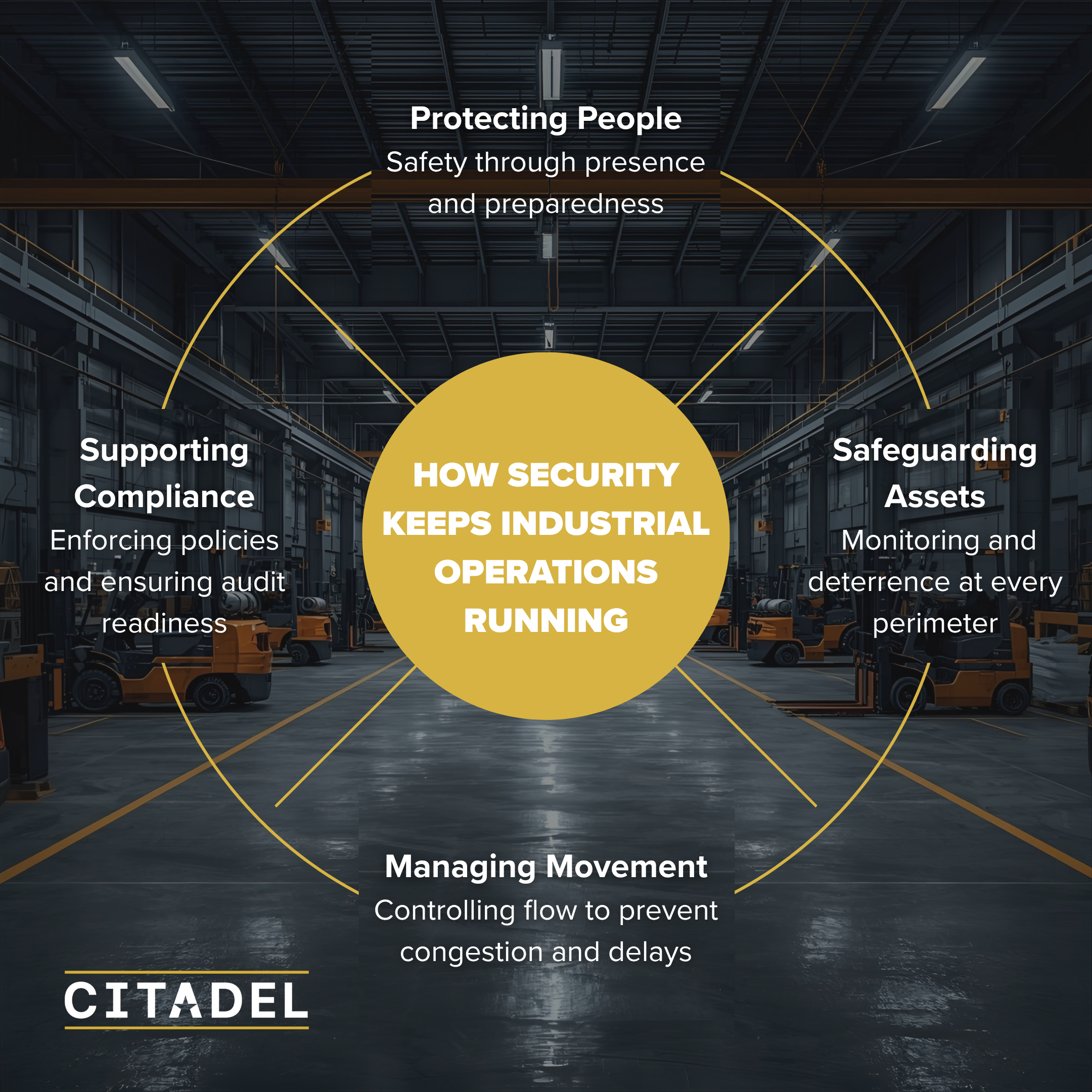
- Protecting people: Ensuring employee and contractor safety through presence, observation, and emergency preparedness.
- Safeguarding assets: Monitoring storage yards, production floors, and perimeter access to deter theft or tampering.
- Managing movement: Overseeing truck entry, shift changes, and visitor access to prevent congestion or delays.
- Supporting compliance: Documenting incidents, enforcing safety policies, and ensuring audit readiness for OSHA or regulatory inspections.
This integration of safety and efficiency turns security into an operational advantage — one that keeps production stable and predictable.
The Role of Technology in Continuity
In modern facilities, visibility and accountability are as critical as vigilance. Tools like GPS tracking, digital patrol logs, and real-time reporting allow leadership to see exactly how security activity supports operations.
A system of technology-enabled oversight means every patrol, inspection, and intervention contributes to measurable outcomes — fewer delays, safer workplaces, and stronger compliance.
This data doesn’t just protect; it improves performance. Trends in incidents, equipment failures, or traffic flow help facilities proactively adjust processes for greater efficiency.
Security as a Partner in Productivity
The most effective industrial security programs don’t operate on the perimeter — they work at the center of operations. Officers trained in situational awareness, hazard identification, and clear communication become extensions of plant management.
They’re not just responders; they’re collaborators — aligning their presence with production priorities, shift schedules, and maintenance routines. When security works in sync with operations, protection becomes invisible — but its impact is felt in every smooth transition, on-time shipment, and safe workday.
Continuity Is the New Benchmark
Industrial resilience isn’t just about equipment and process control — it’s about people, readiness, and prevention. Security plays a direct role in maintaining that readiness, bridging the gap between safety and productivity.
As supply chains expand and facilities automate, one truth remains: operational continuity depends on proactive, adaptable, and integrated security.
Ready to Strengthen Security Around Your Operations?
Citadel Security provides industrial protection that goes beyond the perimeter — aligning with your operational goals to reduce downtime, improve safety, and sustain productivity.
Contact Citadel to learn how security can become a driver of operational continuity.


.png)

.png)