When organizations think about security, they usually picture the visible pieces:
a guard at the entrance, cameras mounted around a building, patrol vehicles circulating a property.
Those elements matter. But they are only the outer layer.
The effectiveness of a security program rarely depends on how many guards or cameras are deployed. It depends on how well those resources are coordinated.
That coordination layer is called a Security Operations Center (SOC).
And in modern security environments, it often determines whether incidents are prevented — or simply recorded.
Security Failures Are Often Coordination Failures
In most environments, security systems don’t fail because no one was watching.
They fail because the system behind the watchers breaks down.
Common breakdowns include:
- Alerts triggered but not verified quickly
- Officers responding without full context
- Incidents reported but not escalated properly
- Cameras recording events that no one actively monitors
- Communication gaps between field teams and leadership
Individually, these gaps seem minor. But together they create fragmentation — a collection of security measures operating independently instead of as a unified system.
This is the problem a SOC is designed to solve.
A SOC Turns Individual Security Measures Into a System
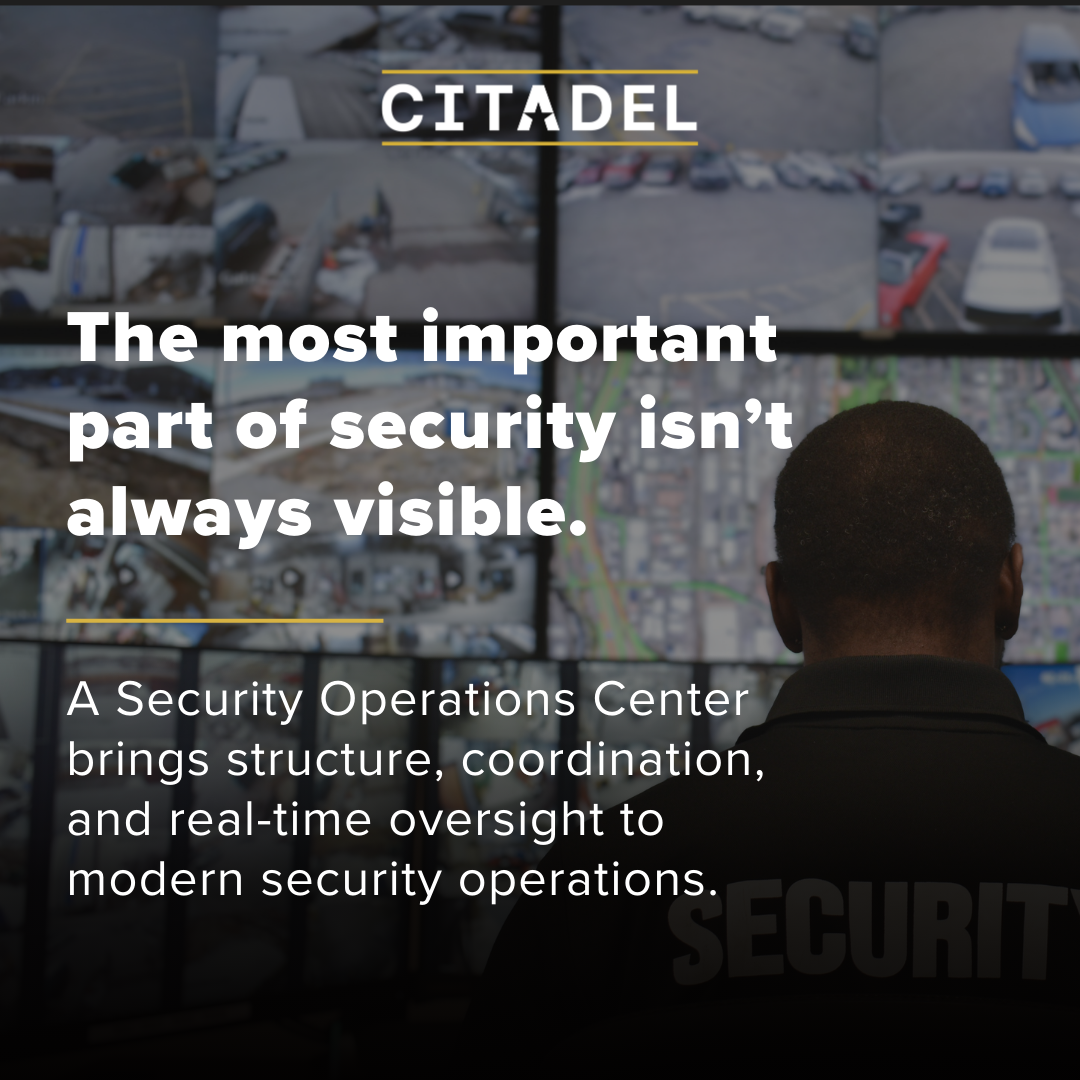
At its core, a Security Operations Center acts as the central command layer for security operations.
Rather than leaving guards, patrol units, and camera systems to function separately, the SOC integrates them into a single operational framework.
From one centralized environment, trained personnel monitor activity, verify alerts, coordinate responses, and document incidents across multiple locations simultaneously.
This structure provides something many organizations lack: real-time operational awareness.
Instead of reacting after an incident is discovered, a coordinated security system can identify, assess, and respond as events unfold.
Why Modern Security Environments Require Centralized Oversight
The environments organizations operate in today are significantly more complex than they were even a decade ago.
Facilities now manage:
- Multi-tenant commercial properties
- Distributed construction sites
- Utility infrastructure spanning large regions
- Retail locations with variable traffic patterns
- Expanding compliance and documentation expectations
At the same time, the cost of security failures has increased. Liability exposure, reputational damage, and operational disruption all carry measurable consequences.
In these conditions, decentralized security becomes difficult to manage.
A centralized SOC introduces structure where fragmentation once existed.
What a SOC Actually Does
A well-run SOC is far more than a room of surveillance monitors.
It functions as an operational hub that supports security teams in the field and ensures incidents are handled consistently and professionally.
Typical responsibilities include:
- Continuous monitoring of camera systems
- Verification of alarms and alerts
- Dispatch coordination for patrol units
- Escalation management for incidents
- Real-time communication with field officers
- Documentation and reporting of events
- Evidence management for investigations
- Monitoring the health of security systems
In practice, the SOC becomes the operational backbone of the security program.
The Difference Between Watching and Knowing
Many organizations assume cameras alone provide oversight. But cameras only record information. They don’t interpret it.
Without coordination, surveillance systems often become passive tools — documenting events after they occur rather than helping prevent them.
A SOC changes that dynamic by introducing human judgment and operational structure into the monitoring process. Instead of simply watching screens, SOC teams interpret signals, identify anomalies, and guide response decisions.
That difference turns surveillance into situational awareness.
Peace of Mind Is Not a Feeling — It’s a System
Clients often describe the value of security as “peace of mind.” But in reality, peace of mind is not emotional — it’s operational. It comes from knowing that:
- Someone is monitoring activity continuously
- Alerts are verified and escalated appropriately
- Field teams receive coordinated support
- Incidents are documented and traceable
- Communication flows clearly across the system
In other words, peace of mind comes from structure and coordination.
And that coordination is exactly what a Security Operations Center is designed to deliver.
At Citadel Security, our Security Operations Center serves as the coordination hub for the environments we protect. Operating 24/7/365, the SOC provides continuous oversight, real-time monitoring, and centralized support for field officers, mobile patrol units, and camera monitoring programs.
By integrating physical officers, patrol operations, remote camera monitoring, and incident reporting into one coordinated system, the SOC helps ensure alerts are verified quickly, responses are dispatched efficiently, and incidents are documented consistently. This structure transforms separate security tools into a unified program designed to support both safety and operational continuity.
For organizations operating across multiple locations or complex environments, centralized coordination provides the visibility and structure needed to manage risk effectively.
Ready to Strengthen Your Security Program?
If your organization relies on multiple security layers — guards, patrols, cameras, or monitoring systems — a Security Operations Center can help unify them into a single coordinated strategy.
Citadel’s SOC supports clients across commercial properties, industrial sites, construction projects, and multi-location operations.
Contact Citadel Security to learn how centralized security oversight can strengthen protection, improve response coordination, and provide greater visibility across your security program.


%20(1).png)
.png)